
Ah, peak season.
It's Monday morning, and the peak surcharge on your ground service took effect today. Orders are already shipping based on it, but the invoice that reflects today's shipments arrives next week. That's a lot of time to be blindly selecting a carrier without considering the complete cost implications, especially given the volume that's shipping at this time of year.
The carrier rule you wrote in August doesn't know about the surcharge, so if your team doesn't manually change it, it'll just keep routing orders to the service that was cheapest last week. Peak makes it that much more difficult to select the right rate and make sure that's what you actually pay.
Both problems are very difficult to solve after the label prints, which is why we're enabling a more proactive — and effective — approach.
The surcharge should be priced in before the label.
Shipium rates every order against your contracted prices as they stand on a given day, peak surcharges included. If we think about this in the context of our Monday order, that means:
- Your contract is already in the platform, and the carrier's published peak surcharges are kept current, so no one (your team, a vendor) needs to manually account for changes.
- Shipium rates every eligible service under that contract, accounting for your promised delivery date and other constraints.
- Let's say you promised a customer they'd get their order by Friday. Even if the carrier's default transit table for a specific service says it'll arrive by then, if Shipium's modeling determines that you'll be late, that service is filtered out.
- In the end, the cheapest service that meets your date (and other requirements) is selected. This doesn't just help reduce the risk of missing dates, but also frequently helps our customers identify and use on-time ground methods.
With up-to-date surcharges included during every rate shop, shippers can select carriers with more confidence and improve business outcomes as a result.
The audit should start at the label.
Picking the right rate only helps if it's also the rate you pay. As we covered above, every shipment rated in Shipium carries a complete expected cost. When the label is created, most carriers send back their own calculated cost for the same shipment. As we know, unfortunately, those two numbers don't always match.
A traditional audit waits for the invoice to arrive. It rebuilds what each shipment should have cost (a best guess) and works backward from there, weeks after packages have shipped. During peak, that means a billing error that starts on a Monday can repeat across thousands of shipments before anyone knows.
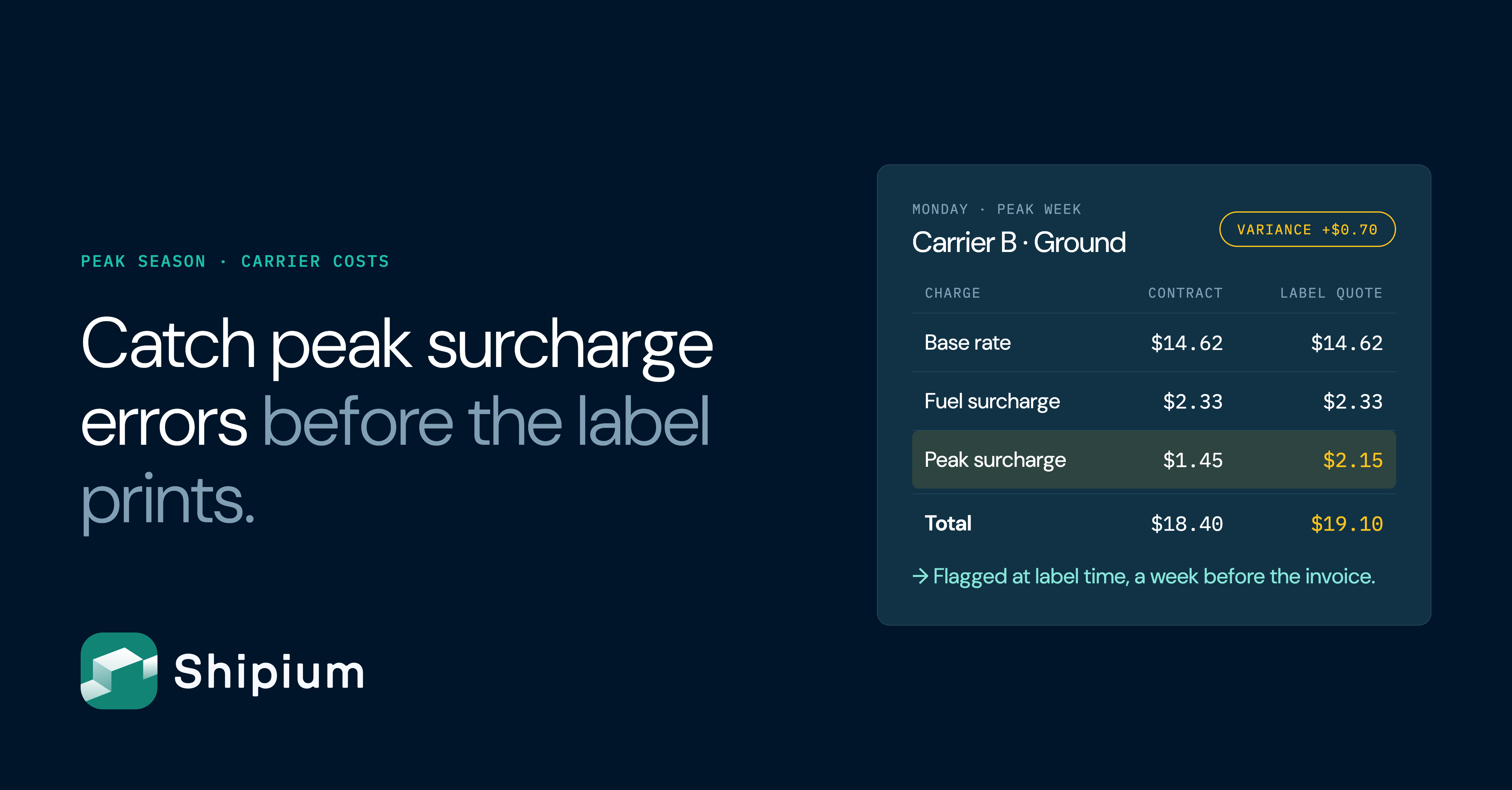
Shipium provides a forensic solution that conducts four-way validation across your contract, invoice, rate, and label. By comparing the carrier's label quote to your contract as soon as it's created, any mismatch shows up on the day the package ships.
So, given our scenario, if label quotes come back without the peak surcharge discount you negotiated, each one is identified as having a variance that same day. Sonar then groups every variance with the same cause into a single "finding", so a discount missed on thousands of labels becomes one grouped issue with the evidence attached for the carrier.
This is also useful for problems that build more gradually. For example, when label costs start drifting from your contract, Shipium can flag it and leverage our agentic platform to look for an updated rate card. By the time the invoice arrives, every label has already been checked, with each invoice line tied out the cent.
It's about more than your contracts and invoices.
At peak, the least damaging errors are those stopped before the label. Shipium prices the surcharge into the carrier decision, then holds the label quote, and later the invoice, to that price.
That's why truly effective audit relies on more than just your contract and invoice. By incorporating rating and labeling, you can validate more thoroughly and catch errors that wouldn't have been possible to see with a traditional audit approach.
If you're interested in learning more, connect with our team here → Contact Us