



This week diesel set an all-time record. The DOE national average hit $6.285 a gallon for the week of September 14, up 32 cents in seven days, past the June 2022 peak that everyone in this industry treated as the ceiling.
So this is a terrible week to argue that fuel surcharges are no longer correlated to the fuel market.
Let’s argue it anyway. FedEx’s posted ground fuel surcharge is 28.00%. Run that number backwards through the table FedEx published in 2018, using the step rule FedEx printed on that same table, and you need diesel at $10.66 a gallon to get there.
$6.285: Record diesel, week of Sep 14
$10.66: Diesel implied by the 2018 table
We just set a record and we’re still $4.38 short.
Somewhere in your building there’s an analyst who already checked. Pulled up the DOE site, found the weekly number, put it next to the carrier’s posted percentage, and could not make the two agree. Their math is fine. They’re hunting for a formula that stopped existing around 2023.
Five numbers, then three moves.
Every figure comes from the carriers’ own published documents or from DOE. These are the conclusions. The reasoning behind them is in the full piece, and you’ll want that before you take any of this into a negotiation.
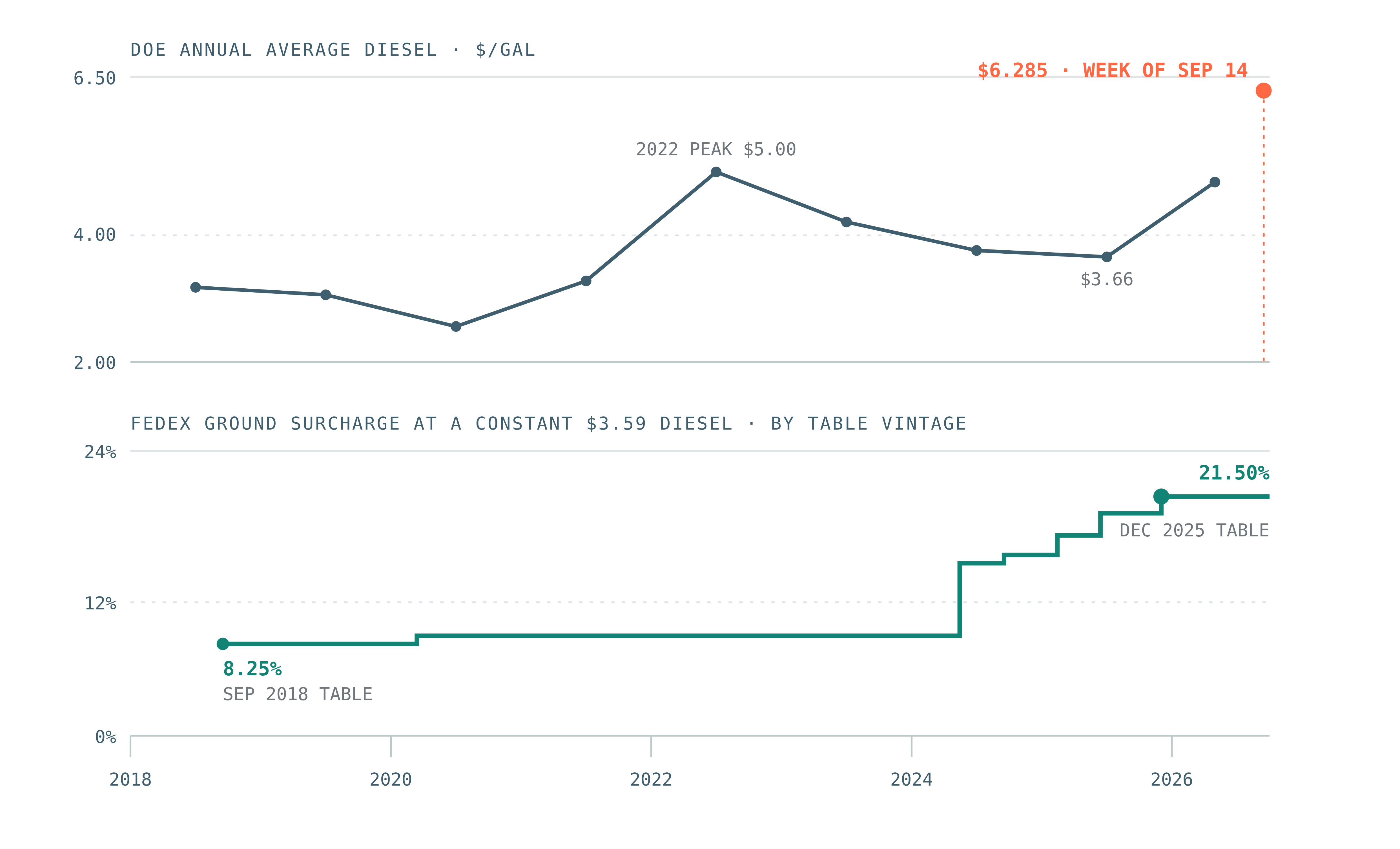
Same fuel price, 2.6 times the surcharge. At $3.55 to $3.64 diesel, FedEx Ground charged 8.25% under the September 2018 table and 21.50% under the December 2025 one. Identical fuel price, identical service.
Record diesel still doesn’t justify the current rate. Diesel hit an all-time high of $6.285. The 2018 table, extended by FedEx’s own rule, charges 15.75% there. The posted rate is 28.00%.
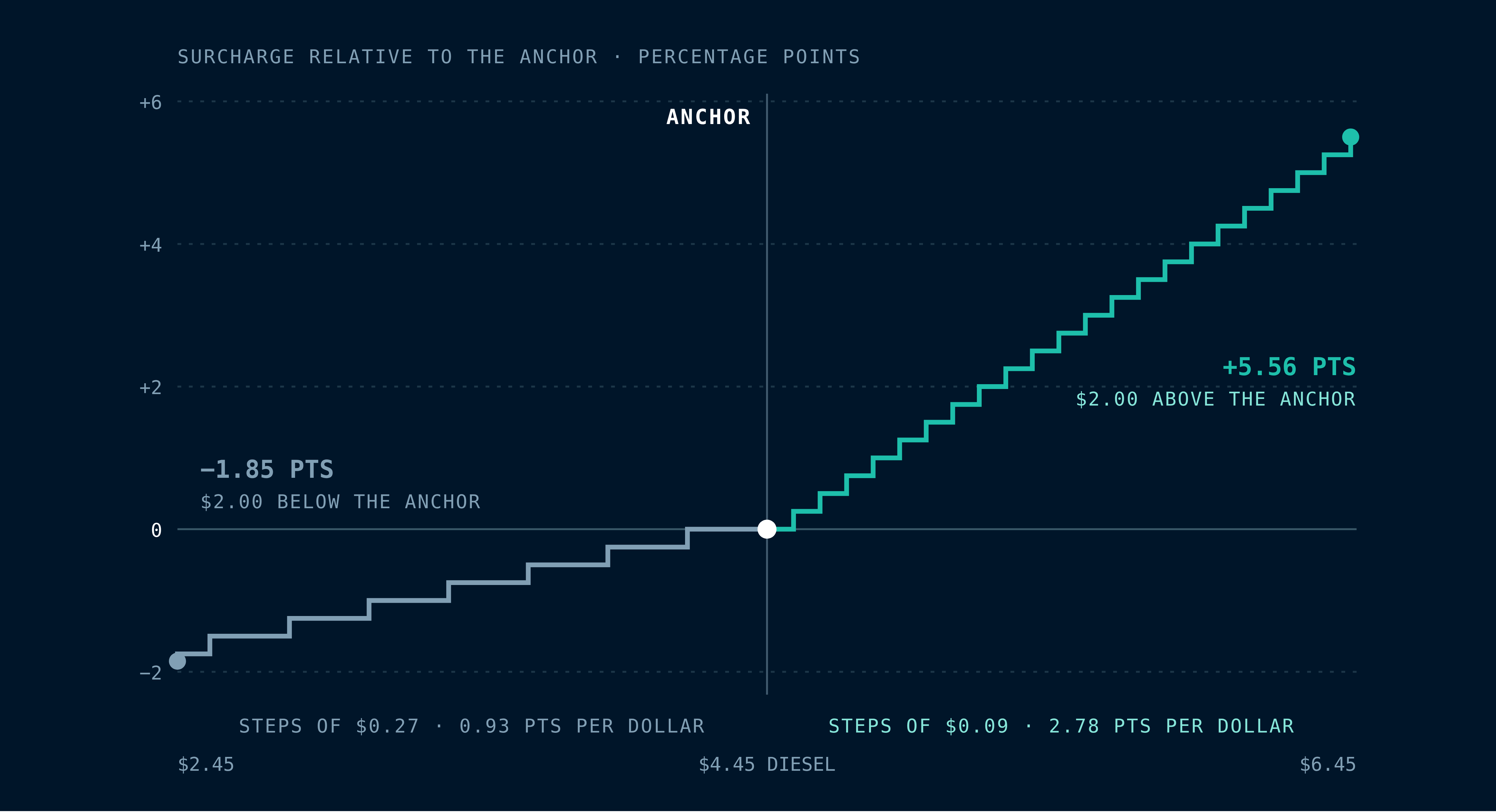
The table is three times steeper going up than coming down. Above the $4.45 anchor the range extends in $0.09 steps, below it in $0.27. A dollar of diesel costs you 2.78 points; a dollar of relief returns 0.93.
Your fuel line grew about six times over. On a 5 lb ground residential parcel the fuel charge went from $1.04 in 2020 to $7.21 in 2026 at list. Fuel prices explain 18% of that. Table re-basing is 44%, base and accessorial inflation 38%.
Their own fuel bill went down. FedEx fuel expense fell from 5.58% of revenue in FY2019 to 4.28% in FY2026, and has never exceeded about 7% of either carrier’s operating cost. Put that next to a 28% surcharge.
Three moves, in this order.
Pin the dated table in your agreement. A cap or points off helps, but neither stops a re-base. Name a dated table in the agreement and hold it for the term. Two structural re-bases landed in 2026 alone, and almost nobody is asking for this.
Go after the accessorial base. Fuel is charged on the net rate plus most surcharges, so at 28% every accessorial dollar costs you $1.28. Getting a carton under 10,368 cubic inches drops the additional handling fee and the fuel on it.
Audit the four weeks after every table change. UPS republished on January 5, March 9, April 13 and August 10 this year, and fuel errors cluster in those windows. Run the full population and check your dispute clock, which is probably 90 to 180 days.
Shipium Compass: know what your own fuel exposure looks like before the next renewal. Compass benchmarks your billed fuel percentages against the published tables, separates table re-basing from real fuel movement on your own freight, and gives your team the language to pin a table in the redline. Talk to Compass →
Picking up from March
Back in March I wrote about fuel taking a bigger and bigger bite out of what it costs to deliver a package to your customer. That piece made the observation. This one exposes the divergence and the mechanism behind it, using DOE price data, the carriers’ own published surcharge tables going back to 2018, and their 10-K filings.
What I found is worse than a trend line.
A disclaimer
Everything in this piece is anchored to published list rates and published surcharge tables. None of it accounts for negotiated discounts. That omission is deliberate.
Your team fights hard for those discounts. They’re real money, they get defended every renewal cycle, and a well-run program pays meaningfully less than what’s in these tables. If you have a strong agreement, your dollar figures are lower than mine. Congratulations! That’s the job, and the people who do it well deserve the credit.
The percentages are a different story. A discount off your base rate does nothing to the shape of the fuel table, and nothing to the fact that fuel gets charged on top of your accessorials. That structure sits above your contract. It moves every Monday whether you negotiated brilliantly or not at all.
So read the dollar amounts here as illustration. The ratios are the point.
Narrow, and I’ll say it plainly.
Fuel surcharges are no longer about fuel.
What was built as a pass-through now works as a profit lever for the national carriers. And because it’s charged as a percentage of a base that keeps inflating, the effect compounds rather than adds, which is why your fuel line has grown faster than your rates, faster than your accessorials, and several times faster than diesel.
That’s the claim. The rest of this is the evidence.
One test settles it
There’s an argument the carriers make, and on its own terms it holds up. The index is real. It’s DOE data, published weekly, public, auditable. The lag is one week and they disclose it. Nobody is cooking the diesel number.
One thing to add to that concession, because it cuts the other way. The DOE series is a retail price. It’s what a truck pays at a public pump, with excise taxes and station margin in it.
That isn’t how a national carrier buys diesel. Line-haul fuel goes into company fueling facilities in bulk, contracted upstream and hedged, which puts the carrier’s cost basis on wholesale rather than at the pump. Wholesale carries neither the retail margin nor the same tax load, and retail is slower to fall than wholesale when spot prices drop.
So the price your surcharge is indexed to is not the price the carrier’s fuel bill is indexed to. Over a year the two track each other. Week to week, and especially on the way down, the shipper is carrying volatility the carrier has already engineered around.
All true, and all beside the point. The money is made in the table.
So hold the fuel price completely still. Pick one diesel price and look up what each published version of the table charges at that price. Fuel price movement drops out of the comparison entirely, and all you’re measuring is the table.
FedEx Ground, at $3.55 to $3.64 a gallon
UPS looks the same. At roughly $4.00 diesel, UPS Ground was 9.75% under the March 2020 table, 12.75% under the January 2022 table, and 24.00% under the April 2026 table. Domestic air at $2.10 jet fuel: 8.75% in 2020, 21.00% in 2026.
Now run it the other direction, at this week’s record price.
Diesel is $6.285. FedEx’s 2018 table, extended by FedEx’s own published rule of a quarter point per nine cents, produces a 15.75% ground surcharge at that price. The current posted rate is 28.00%.
Twelve and a quarter points of daylight, at the highest diesel price this country has ever recorded.
For anyone who tells you this is more complicated than it looks: FedEx’s December 1, 2025 table reproduces the posted rates exactly. At the August 31 reading of $5.599 it gives 27.00%, which is what FedEx charged the week of September 7. At the September 7 reading of $5.967 it gives 28.00%, which is what FedEx is charging right now. The arithmetic is not in dispute. Only the table is.
Diesel goes up and comes back. The table only goes up.
Meanwhile, out in the real world
Annual average diesel, from DOE: $3.06 in 2019, $3.66 in 2025. Up about 20% over six years. Jet fuel over the same window went from $1.88 to $2.12, up about 13%.
The ground surcharge at a fixed diesel price rose 161%. The air surcharge at a fixed jet price rose 140%.
And this year’s spike doesn’t rescue the story. Diesel at $6.285 is 106% above the 2019 average. Over that same stretch the posted ground surcharge went from 6.75%, which is what the 2018 table charges at 2019’s average diesel price, to 28.00%. Fuel roughly doubled. The surcharge went up more than fourfold.
Even measured at today’s record price, the posted rate is 78% higher than what the 2018 rules would produce. A pass-through cannot run four times faster than the cost it passes through. Whatever this line item is, it isn’t that.
Fuel didn’t do that. The table did.
The table is asymmetric, and it says so
This one surprised me, and yet it didn't. You don’t have to infer intent, because UPS published the mechanism.
“If the Fuel Surcharge falls outside the published range: (i) for fuel prices above $4.45, the range will extend in $0.09 increments and the Fuel Surcharge will adjust in 0.25% increments; and (ii) for fuel prices below $4.45, the range will extend in $0.27 increments,” says the UPS domestic fuel flyer.
It is easy to misread. The $4.45 is the anchor of the published table. Both clauses describe how the table extends away from that anchor, one going up and one going down.
Going up, the range extends nine cents at a time and the surcharge moves a quarter point with it. That’s 2.78 points for every dollar of diesel. Going down, the range extends twenty-seven cents at a time for the same quarter point. That’s 0.93 points per dollar.
Three to one. Explicit in the tariff.
Precision matters here. The table is a lookup against whatever diesel costs this week. If diesel runs up a dollar and comes all the way back to where it started, you land on the same row and pay the same surcharge. There is no residual hiding in the index, and anyone who tells you otherwise is misreading the flyer.
What the asymmetry does is price the two directions differently. Above the anchor you’re on a fast escalator: a dollar of diesel costs you almost three points. Below it the escalator barely moves: a dollar of relief returns less than one. A two-dollar spike above $4.45 adds 5.56 points. A two-dollar fall below it gives back 1.85.
The table is steep where fuel hurts you and nearly flat where it would help you. That isn’t a pass-through. A pass-through is symmetric.
The part that never comes back is the table itself, and that gets re-written more often than the price of diesel.
Steep above the anchor. Nearly flat below it.
The increase you can’t see when you’re paying it
UPS made two structural changes to the ground table in 2026, and they work differently from a rate increase.
On August 10, the pivot point moved from $4.45 to $4.99 and the surcharge at the pivot went from 24.50% to 26.00%. Diesel that day was $5.26, sitting above the new pivot. So the change did almost nothing to invoices that week.
It permanently raised every rate below $4.99.
Run the consequence yourself, off the two published tables. If diesel comes back to $3.90 from this year’s peak, the surcharge lands at 24.75%. At that same $3.90 in early March it was 22.75%. Two points that never come back. And the August 10 change went up without an announcement on the UPS rate updates page.
That’s the design. Invisible on the way in, locked in on the way down.
Two more things worth knowing about the tables
They don’t go to zero. UPS’s March 2026 ground table bottoms out at 21.00% when diesel is $2.47. Domestic air bottoms out at 20.75%. If the carriers got fuel free tomorrow, the table would still bill you north of 20%.
FedEx stopped showing its work. The 2018 FedEx table stated the extension math in plain text: each $0.09 increase results in a 0.25% increase. Every table from 2023 forward says only that the table “will be extended.” No step size. A shipper today cannot compute what happens outside the published range.
Why your fuel line grew faster than the surcharge rate
The percentage is only half of it. The other half is the number that percentage gets applied to, and that is where the real damage sits.
The fuel surcharge is charged on your transportation rate plus a long list of accessorials.
FedEx says so on its own page. Fuel is assessed on the net package rate plus additional handling, address correction, delivery area surcharge, signature options, hazardous materials, oversize, residential delivery, all four demand surcharges, “and any temporary surcharge(s) currently in effect.”
UPS used to enumerate ten items. Its 2026 flyer now reads: fuel applies to all transportation charges “and certain other accessorial charges, value added charges, surcharges and other charges.” The list moved to a separate document UPS can revise without touching the fuel page. UPS also expanded the list twice on the record, adding address correction, chargeback fees and dangerous goods in August 2024, and weekly pickup fees in March 2025.
So the surcharge rate went up. And the items it’s charged against also increased. Those two don’t add. They multiply.
Do the math on one parcel
A 5 lb ground residential parcel to a delivery area ZIP, at list rates. The accessorial dollars below are carrier-published.
5 lb ground residential · delivery area ZIP · list rates
+79%: Invoice total, 2020 to 2026
+590%: The fuel line on that parcel
+89%: Annual average diesel
And fuel went from 5.7% of that invoice to 21.9% of it.
Where the $6.16 came from
Split the increase in the fuel line three ways, in order:
Eighty-two percent of the price increase for fuel has nothing to do with fuel.
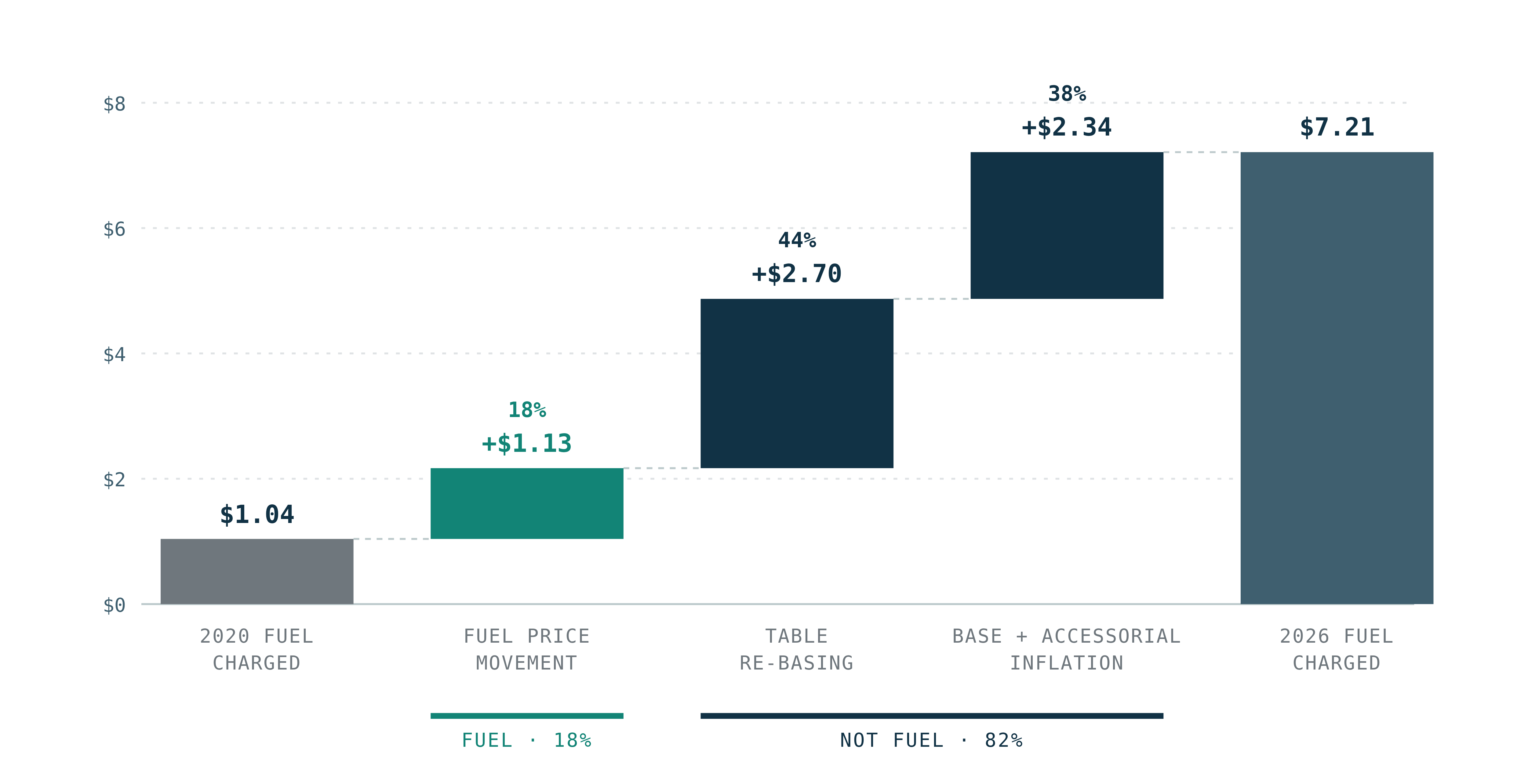
Fuel comes third. The general rate increase everyone spends December arguing about comes second. The table wins and your budget loses.
The 1.28 multiplier
For an operator, that compounding has a simpler form. At a 28% surcharge, every accessorial dollar on your invoice costs you $1.28.
Which means the last six years of accessorial increases are worse than they look:
Accessorials at list, with the 1.28 multiplier applied
And there’s a set of changes that widened the base without touching a single published rate:
- Every dimension rounds up to the next whole inch, both carriers, since August 2025. An 11.1 by 8.5 by 6.2 box goes from 5 lb dimensional to 6 lb. Fuel rides on all of it.
- Additional handling and oversize now trigger on cubic volume, not length plus girth, since January 2026. Different packages qualify. Most contracts were written against the old definition.
- A 10 lb parcel that trips additional handling by dimension bills at 40 lb.
- Delivery area surcharge went urban. The 2024 expansion added ZIPs in Boston, the Bronx, Brooklyn, Chicago, Los Angeles and San Francisco. It now covers more than half of U.S. ZIP codes.
- Peak got long. UPS peak additional handling ran six weeks in 2019. This year it runs sixteen, from September 27 to January 16. Peak surcharges carry fuel.
None of that shows up as a percentage in any rate announcement. All of it raises the number your fuel percentage multiplies.
Their fuel bill went down
The carriers’ own filings settle it.
FedEx’s fuel expense was 5.58% of revenue in fiscal 2019. In fiscal 2026 it was 4.28%. As a share of what it costs FedEx to move packages, fuel fell from 8.08% to 6.25%.
Down 23%, on both measures. Over the same seven years, the ground fuel surcharge at a fixed diesel price went up 161%.
One goes down. One nearly triples. Indexed to 2019 = 100.
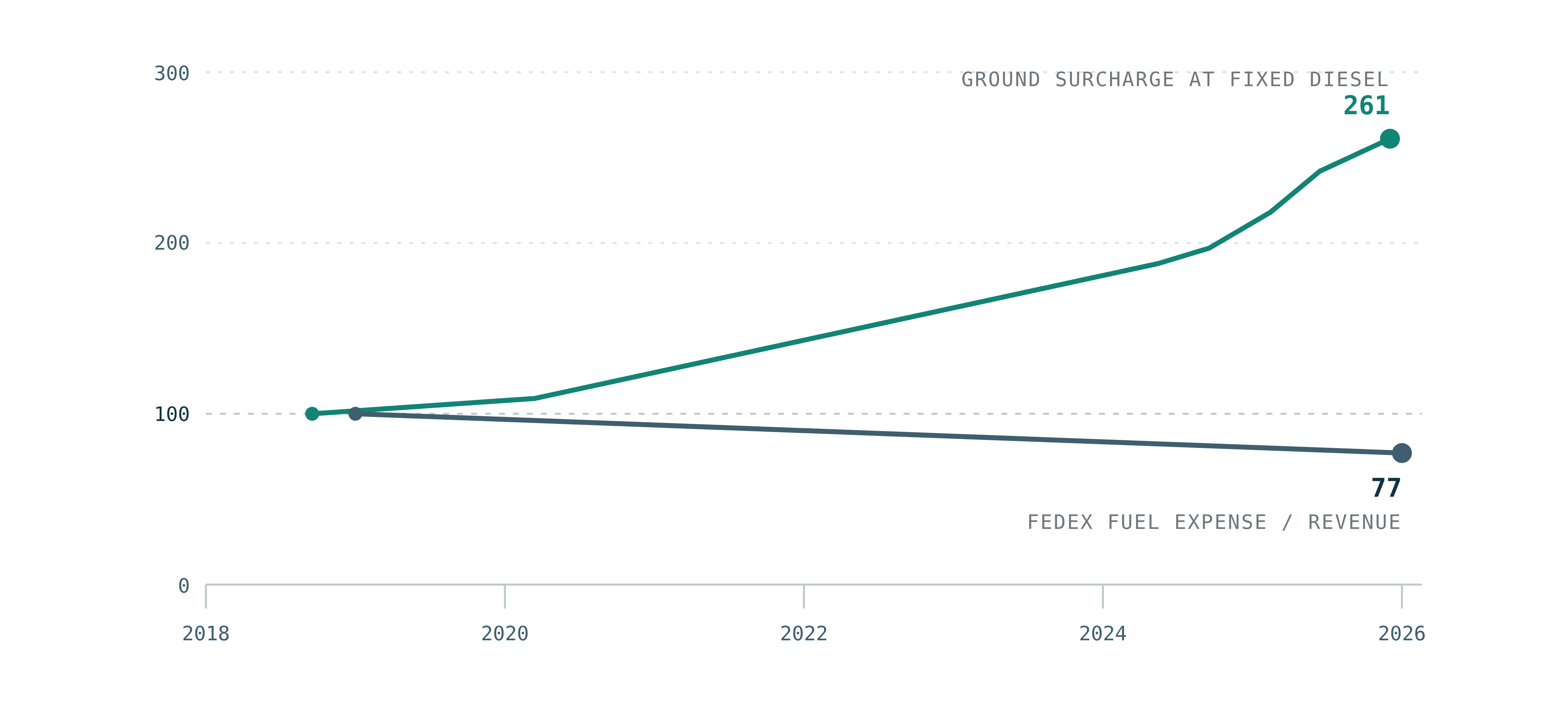
Fuel has never been more than about 7% of either carrier’s total operating cost. It sat under 5% in four of the last eight years. Hold that number next to a 28% surcharge and decide for yourself what the surcharge is recovering.
UPS is a more mixed picture, and it’s worth being straight about that. Its fuel share of direct cost went from 5.81% in 2019 to 6.48% in 2025, up modestly. But UPS’s purchased transportation line fell 44% over that stretch, from $19.1 billion to $10.6 billion, which shrinks the denominator and lifts the ratio on its own. The ratio moved because the base shrank.
What neither of them will tell you
Neither UPS nor FedEx discloses a dollar total for fuel surcharge revenue. Not in a single year from 2019 through 2026. They’ll describe the mechanism in detail across multiple pages of a 10-K. They won’t say what it collects.
One year got out. In its fiscal 2022 10-K, UPS disclosed a $3.0 billion increase in fuel surcharge revenue. Its fuel expense that year rose $2.171 billion.
$829M — The gap, in twelve months
Surcharge revenue grew 38% faster than the cost it exists to recover.
"As a former Procurement leader, pricing transparency and principles were the most important aspects of supplier relationships, and especially the negotiations with them. Without clear, logical, indexed pricing methods, your budget and margins are vulnerable to changes that may have nothing to do with market conditions. When words do not match actions, trust erodes and you start looking for options to give you a better footing. And here we are in a heavily diversified parcel market where simplified pricing and innovative solutions are rewarded with growth and market share."
And then they said it out loud
“Our fuel surcharge is never truly a pure pass-through, but it’s typically a net positive for FedEx Freight above our cost of fuel.” John Smith · CEO, FedEx Freight · Q3 FY2026 earnings call, March.
“From a fuel surcharge perspective, the price of fuel, it’s not that relevant. The index takes care of it.” Brie Carere · Chief Customer Officer, FedEx · Same call.
“our fuel surcharge indexes protect us from impact to profit” UPS · May, explaining an international increase.
“This growth includes a 5-percentage-point benefit from fuel price-driven surcharge revenue.” Brie Carere · Q4 earnings call, June · Walking through revenue growth.
The last one matters most, because it describes revenue rather than cost. Brian Dykes, UPS’s CFO, did the same thing in January, breaking an 8.3% improvement in revenue per piece into base rates, mix, and “the remaining 170 basis point increase was from fuel.”
When a carrier reports fuel inside its yield bridge, it has told you the surcharge is a price.
The fair counterargument
Both carriers say fuel is roughly margin-neutral right now, and in a high-fuel year they have a case. FedEx’s interim CFO said the surcharge increase “was not a material driver of our adjusted operating income.” Carol Tomé told UPS investors there’s “a benefit right now to the top line, not so much on the bottom line because we’re just covering our costs.”
Take both statements at face value. They still prove the point.
The tables were re-based through 2024 and most of 2025, while fuel was falling. Those re-based tables were sitting in place when diesel spiked in March 2026. Being margin-neutral at $5.46 diesel is only possible because the table got lifted seven times at $3.60 diesel.
The interesting question is what happens on the way down. The April and August re-bases already answered it. The $0.27 step means falling diesel gives back a third of what rising diesel took, and the re-based table means the floor it falls to is higher than the one it left.
Fuel didn’t do that. The table did.
What you can do about it
You can’t argue the index. It’s real. You can absolutely argue the table, the base, and the bill.
At the negotiating table
Ask for these in this order. The first two get granted routinely.
- Points off the published table. Write "percentage points." A phrase like "a 10% discount on fuel" is ambiguous, and the billing system will pick the cheaper reading.
- Fuel calculated on the net rate after discounts. This gets mis-specified in the agreement constantly, and it's often worth more than a point off the surcharge.
- A pinned table. This is the big one and hardly anyone asks. Language along these lines: fuel surcharge shall be assessed using the carrier's ground fuel surcharge table published and effective [date], which shall remain in effect for the term notwithstanding any subsequently published table. A cap protects you at the top. A pinned table protects you from the next re-base, which is where the money leaks.
- Change control. Sixty days notice and your written consent before any off-cycle change to the table, index, or methodology. UPS made an unannounced structural change in August. Make that a breach next time.
Ask your rep which dated table your agreement is priced against. The pause before the answer is usually the most informative part of the meeting.
One warning: do not negotiate fuel as a standalone line. Model it in the same redline as your tier thresholds, your minimum charge, and the surcharge trigger definitions. A two-point fuel concession on a $15 package is worth about thirty cents. A minimum charge moving from $11.99 to $13.00 across a light-parcel tail eats that several times over, and the carrier knows exactly which of those two numbers you’re watching.
On the network
Only two alternatives have a genuinely different fuel mechanism at scale.
USPS — flat 8%. Now at a flat 8% on Ground Advantage, Priority, Priority Express and Parcel Select, running April 26, 2026 through January 17, 2027. Yes, USPS finally added a fuel surcharge, and it said the quiet part in the press release: the increase “is less than one-third of what our competitors charge for fuel alone.” Stack the 6% peak surcharge on top if you’re modelling Q4.
Amazon Shipping — 14.50% to 18.00%. Publishes a diesel-indexed table running 14.50% to 18.00%. At comparable diesel that’s eight to twelve points below UPS and FedEx.
OnTrac runs the same index, the same one-week lag, and posted 26.75% for the week of September 21. Moving to OnTrac to escape fuel does not work. Move for the base rates and accessorials, and budget the same fuel. DHL eCommerce charges per pound rather than per percent, which helps heavy parcels and hurts light ones, and it raised that per-pound rate 93% in a single move in May.
For the newer regional networks, most publish nothing. So make it an RFP requirement: the fuel table, the list of fuel-applicable charges, and a dated ZIP coverage file, in writing, before you model a single lane.
And weigh the downside honestly. Saving three to five dollars a package by diverting volume can trip a revenue tier penalty with your incumbent that costs more than the savings. Model the break-even before you sign anything.
In the operation
This is the part most teams skip, and it’s the part with the multiplier. Every dollar you take out of the base takes about twenty-eight cents of fuel with it, automatically, with no negotiation required.
Zone skipping (the biggest lever). Two to five dollars a parcel against fifty cents to a dollar fifty of consolidation cost. It needs roughly 500 or more daily parcels from one origin and tolerance for twelve to twenty-four hours of added transit. It attacks fuel twice: it collapses the zone, and it moves miles out of a percentage-of-rate world into a per-mile one.
Cube control (the fastest win). Getting a carton under 10,368 cubic inches removes the additional handling fee and the fuel on it. And negotiate the dimensional divisor while you’re in there. Standard is 139, 166 is reachable, and high-volume shippers push toward 200.
Route on landed cost (a weekly habit). Fuel now varies by ten to twenty percentage points across carriers at the same diesel price. If your rate shopping runs on base rates and an annual contract table, you’re leaving that spread on the floor every day.
On the invoice
Parcel audit recovery runs 3% to 7% of spend, and fuel errors are a real share of it. The common ones: the wrong week’s index applied, the air table applied to a ground shipment, fuel computed on list instead of net, fuel applied to a charge your agreement exempts.
Verifying a fuel charge takes four inputs
- The DOE reading for the week of pickup, which is often not the week you were invoiced.
- The carrier’s published table for that week and that service tier.
- Your agreement’s language on indexing, discounts, and exemptions.
- The actual pickup date by tracking number.
Run the full population, because fuel errors cluster around table-change dates. UPS republished on January 5, March 9, April 13 and August 10 this year. Those four windows are where the money is, and your dispute clock is probably 90 to 180 days, which means January is already gone.
One more thing. UPS charges the greater of a flat fee or 12% of the adjustment to process a billing correction. They make money when you catch their error. Budget for it and go anyway.