

Logistics optimization means moving goods at the lowest total cost that still keeps the promise made to the customer. For freight, a lot of that work happens in planning. For parcel, most of it happens at the pack station, one box at a time, thousands of times a day.
That second part is carrying more of the cost in 2026. Carrier pricing now moves too often for a routing rule written in January to still be the right rule in October, so the weight shifts to each package's decision.
Key highlights:
- Logistics optimization lowers the cost of moving and storing goods while meeting service targets. It covers network design and carrier contracts as well as the carrier, service, and box chosen for each package.
- Parcel ground costs were projected to hit a record 43.3% above their January 2018 baseline in Q4 2026, according to the TD Cowen/AFS Freight Index.
- Most parcel savings come from decisions made per package at label time, and 2026 pricing changes too often for static rules to keep up.
- Shipium makes those decisions on every shipment using ML transit predictions, fully loaded rating, and hourly volume balancing against carrier commitments.
What is logistics optimization?
Logistics optimization is the practice of planning and executing the movement of goods so that total cost is as low as possible for the service level required. It covers long-range choices, like where to put a warehouse, and short-range ones, like which carrier takes a single box.
Those choices run on very different clocks:
For a long time, running the bottom rows on static rules was a sensible way to operate. Carriers raised rates once a year with the general rate increase, shippers updated their rate cards and routing rules, and those rules held until the next January. A bad contract still can't be fixed at the pack station, so the planning work still pays. What's mostly gone is the once-a-year rhythm it relied on.
Why parcel pricing broke the once-a-year plan
Kyle Langley, VP of Final Mile at Tractor Supply, told FarEye's Last Mile Leaders America conference in August 2026: "GRI is not the only thing we have to worry about every year now."
The general rate increase (GRI) hasn't gone away. Supply Chain Dive reported that UPS set a 5.9% average increase starting Dec. 21, 2026, and FedEx a 5.9% average increase starting Jan. 4, 2027. What's changed is everything that happens between those dates.
FreightWaves, reporting on the TD Cowen/AFS Freight Index in October 2026, found that the parcel fuel surcharge went from 7.75% of the transportation rate in early 2021 to 30% in September 2026. Nearly three quarters of that increase came from carriers adjusting their fuel surcharge tables, not from the price of diesel. In an AFS release, Mingshu Bates, the company's chief analytics officer, wrote that "the fuel surcharge has become a revenue lever for carriers." Carriers, it turns out, are very good at pricing.
Delivery area surcharges are moving too. The same report noted that FedEx reclassified 2,533 ZIP codes from its extended delivery area surcharge to its remote one, which carries a $17.75 fee. Think about that from the shipper's side. A customer address that cost one price to reach in January can cost a lot more by fall, and nothing about the order changed. Catching it takes a rating engine that prices every package against current rates; a routing rule written against last year's rate card keeps treating that address as cheap.
In total, the index projected ground parcel costs for Q4 2026 at a record 43.3% above its January 2018 baseline, up 5.8% year over year.
Shippers are responding by spreading volume across more carriers. In FreightWaves' write-up of that conference, Langley described how Tractor Supply's thinking changed: "We had a belief that if we give all of our volume to a single carrier," that would pay off, but "that's not necessarily the case." The report also cited FarEye survey data showing 45.8% of U.S. delivery operators said delivery costs are rising faster than revenue.
A second carrier on the contract saves nothing until something picks it for the right packages. Each carrier brings its own rates, surcharges, service areas, and transit performance. Langley pointed to the catch, too: shift too much volume away from one carrier and you can fall out of a discount tier. So the per-package decision has to weigh each package's cost against the commitments the whole network depends on.
The package-level decisions behind parcel logistics optimization
Jason Murray, Shipium's co-founder and CEO, calls this layer the muck of shipping: the contracts, surcharges, hazmat rules, and outages nobody puts on a strategy slide. For a parcel shipper, it comes down to a short sequence of decisions at label time. Shipium's parcel shipping optimization guide covers each tactic in more depth.
- Check which carriers and services can take the package, and which will arrive by the promised date. That second check works best on predicted transit time from real delivery history, since published service standards are often slower than what a lane really does.
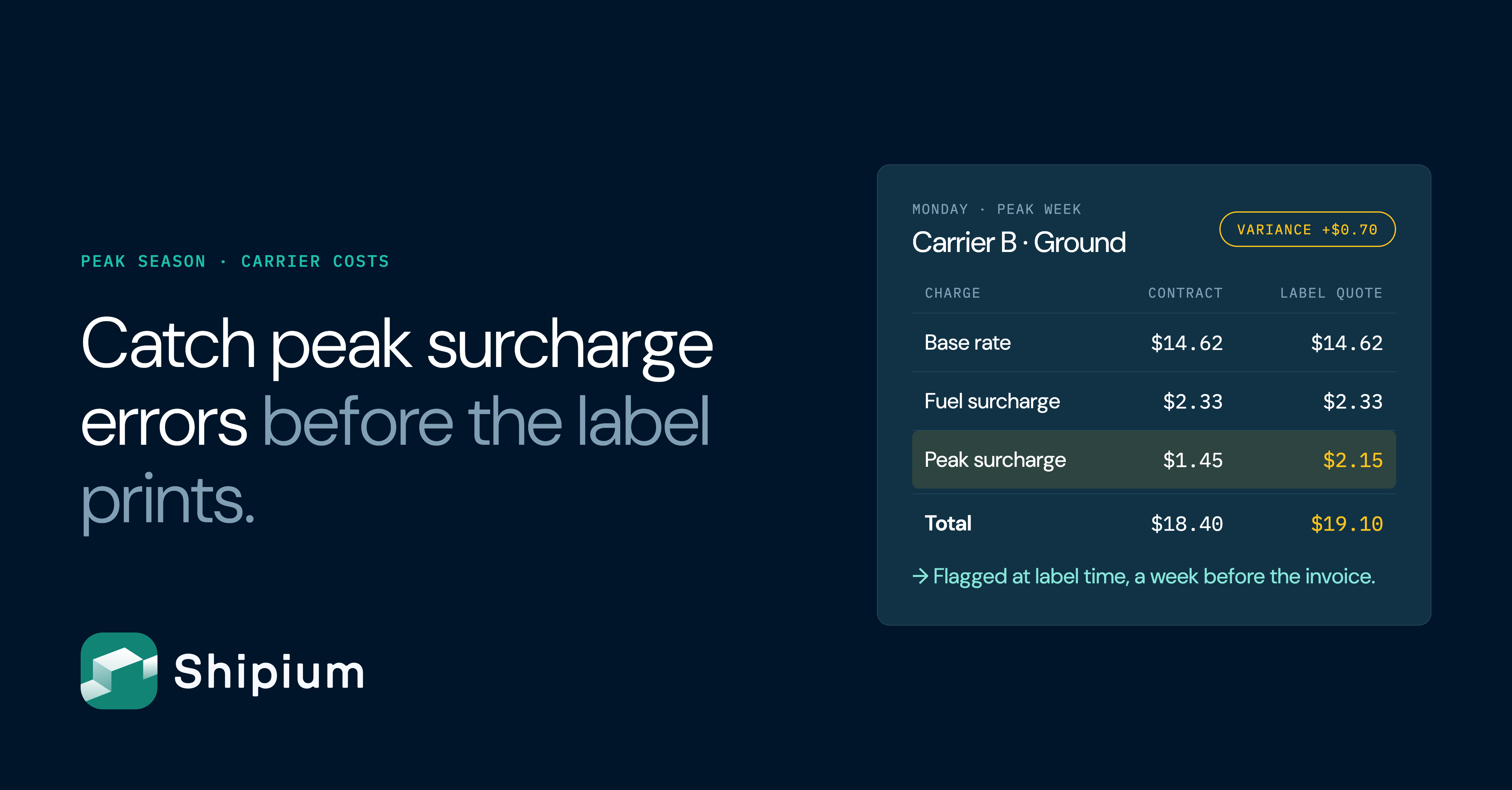
- Price each eligible option with every surcharge included: fuel, residential, delivery area, dimensional weight, and peak fees. A base rate comparison misses the line items that are rising fastest.
- Pick the box before rating. The carton sets billable weight, so choosing it first catches dimensional weight charges while they can still be avoided.
- For heavy or multi-box orders, price parcel and LTL side by side. The two can trade places depending on weight and destination, and a fixed weight cutoff won't notice.
- Check the winner against volume commitments. The cheapest option for this package still has to fit the carrier commitments the contract depends on.
Shippers have made each of these calls for years. What's different now is how often the inputs move, with fuel tables and delivery area lists both changing mid-year.
How Shipium handles logistics optimization at the package level
Shipium runs this sequence on every shipment through APIs that sit alongside a shipper's existing OMS, WMS, and ERP. Its carrier selection checks eligibility, shops the delivery date using ML transit predictions, and rates every eligible carrier with fully loaded costs that include published and unpublished surcharges. Volume is balanced hourly against carrier commitments, and the winning option gets a carrier-compliant label.
The transit predictions do real cost work. Shipium's models predict faster transit than carrier service standards in 40% of cases, which can let a cheaper service make the same date. The models are retrained at least monthly on tracking data from every shipment, so they pick up seasonal and route changes as lanes shift.
The other decisions run in the same flow. Packaging Optimization picks the box using SKU dimensions and carrier-specific DIM divisors. Mode Optimization prices parcel and LTL on the same order and creates a label or a bill of lading, and Zone Skipping runs the same kind of comparison for injection against shipping direct. In a September 2026 FreightWaves interview, Shipium put its typical parcel transportation savings at 12%.
Simulation runs these decisions as predictive scenarios on the same ML models used for live shipping, so the effect on your network shows up before anything goes live. Talk to our team to set one up.